
WhatsApp Business API pricing in India has two bills, not one. Meta charges you per message, and your Business Solution Provider (BSP) charges a separate platform fee on top. This guide breaks down both layers, with the rate card, the changes that took effect on 1 October 2026, and a worked monthly example you can copy.
Key takeaways
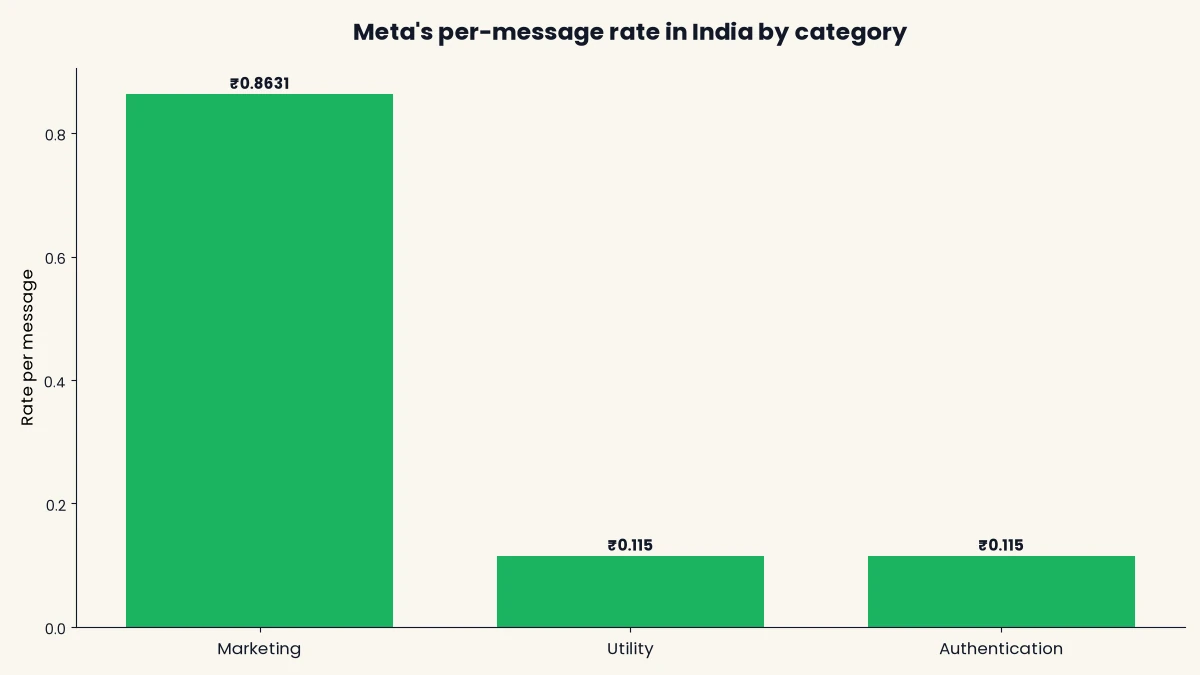
- Meta’s India rates are about ₹0.8631 per marketing message and ₹0.115 per utility or authentication message, before GST. Figures are as reported for January 2026 onward, so check Meta’s current rate card.
- Service messages and utility messages inside an open chat window stopped being free on 1 October 2026. Meta now bills them per message, and service messages get a monthly free allowance per phone number.
- Your BSP’s fee is either a markup on each message or a flat platform fee. A markup grows with your volume, a flat fee does not.
- A small business sending 1,000 marketing and 3,000 utility messages a month pays about ₹1,426 to Meta including GST, before any BSP fee.
In this guide
- How WhatsApp Business API pricing in India works
- Meta WhatsApp business pricing in India: the rate card
- What changed on 1 October 2026
- INR billing and the 31 December 2026 deadline
- BSP fees: the second layer of cost
- What a month actually costs: worked examples
- How to estimate your own monthly bill
- WhatsApp Business API vs the free app: pricing difference
- How DTB’s pricing works
- Questions to ask any BSP before you sign
- Frequently asked questions
How WhatsApp Business API pricing in India works
Meta sets the price of every message. Your BSP sets the price of access: the API connection, the template manager, the shared inbox, and the support that goes with them. Your total bill is the sum of the two, and the BSP layer is where providers differ most.
Meta’s charge: billed per message by category
Since 1 July 2025, Meta charges per delivered template message instead of per 24-hour conversation. The price depends on the message category and, for some categories, on whether the customer’s service window is already open.
- Marketing: promotions, offers, catalogue updates and re-engagement. Always charged per message.
- Utility: order updates, shipping alerts, appointment reminders and payment confirmations. Charged per message when sent as a template. Utility templates sent inside an open customer service window became chargeable on 1 October 2026.
- Authentication: one-time passcodes and login codes. Charged per message.
- Service: free-form replies you send after a customer messages you first. Charged from 1 October 2026, with a monthly free allowance per business phone number.
The BSP’s charge: subscription, markup or both
Most small businesses reach the API through a BSP, a company Meta has approved to provide API access, templates and an inbox. BSPs usually charge in one of two ways, or a mix of both:
- A markup added to every message, expressed as a percentage of Meta’s rate.
- A flat platform fee per month, with Meta’s message charges passed through at Meta’s rate.
“Zero markup” means the BSP passes Meta’s rate through unchanged and earns its revenue from a platform fee only. You can check any provider’s model by asking one question: is the per-message line on my invoice the same as Meta’s rate card? More on this in the BSP section below.
Meta WhatsApp business pricing in India: the rate card
Meta publishes its rates per country and currency on its official pricing page, and updates them through the year. The table below shows the India (INR) rates as reported by WhatsApp partners for January 2026 onward. Before you budget, check the current rate card on Meta’s pricing page, because Meta’s rate cards list effective dates, and the figures here may change.
| Message category | Rate per message (excl. GST) | Rate per message (incl. 18% GST) |
|---|---|---|
| Marketing | ₹0.8631 | ₹1.02 |
| Utility | ₹0.115 | ₹0.14 |
| Authentication | ₹0.115 | ₹0.14 |
| Service (free-form replies) | Free up to the monthly allowance, then the utility rate | Same as excl. GST, plus 18% GST |
Marketing is the expensive category by a wide margin. A marketing message costs about 7.5 times a utility message, so the mix of your templates matters more than the total message count. Utility and authentication messages carry volume discounts, which Meta applies as your monthly volume rises. Service messages do not get volume tiers.
GST at 18% applies to the charges above, based on the reports we checked. Your Meta invoice shows the exact split, so compare it against this table before you rely on the figures.
What changed on 1 October 2026
Two message types that used to be free became chargeable on 1 October 2026. Meta’s developer documentation confirms the change, and it applies to every WhatsApp Business account in India.
- Service messages (free-form replies inside the 24-hour customer service window) became billable. Each business phone number gets a monthly free allowance, and messages after that are billed at the same per-message rate as utility and authentication templates. The allowance does not roll over to the next month.
- Utility templates sent inside an open service window used to be free once a customer had messaged you first. They are now billed per message at the standard utility rate.
Meta has said it does not offer volume tiers on service messages, unlike utility and authentication templates, which keep their volume discounts. If your team spends the day replying to customers on WhatsApp, treat service messages as a recurring cost in your budget, not a one-off change.
The full rules are in Meta’s pricing documentation for non-template messages, which we checked on 5 October 2026.
INR billing and the 31 December 2026 deadline
India moved to rupee (INR) billing for WhatsApp Business Platform on 1 January 2026. This means the rates in this guide are what you see on your Meta invoice, not a dollar conversion. Accounts still on other currencies have to move to INR.
According to Meta partner reports, every WhatsApp Business Account in an eligible business portfolio must be migrated to INR by 31 December 2026. From 1 January 2027, Meta stops delivering messages from accounts that are not on INR.
BSP fees: the second layer of cost
Once you know Meta’s rate, the BSP’s fee is the number that decides your real cost. It is also the number most providers do not show on their pricing page. Here is how to check it.
How a markup works
A markup is a percentage added to each Meta message charge. If Meta charges ₹9,206 for a month of messages and your BSP adds a 10 percent markup on that line, you pay ₹920.60 extra. The markup grows as your volume grows, so a provider that looks cheap at 500 messages a month can cost much more at 20,000.
How a flat fee works
A flat fee is a fixed monthly charge for the platform. Meta’s message charges are passed through at Meta’s rate. The cost is predictable, and it does not rise with each extra message beyond what Meta itself charges.
Look at the invoice line for each message type. If the per-message price is higher than Meta’s rate card, the difference is a markup, and you can work out its size from the numbers on the invoice.
What a month actually costs: worked examples
The examples below use the rates in the table above and do not include any BSP fee, so you can add your provider’s charge on top. All Meta figures include 18% GST.
| Scenario | Messages per month | Meta charge (incl. GST) | DTB plan fee (excl. GST) |
|---|---|---|---|
| Small clinic or single store, appointment and order updates | 500 utility | about ₹68 | ₹500 (Basic) |
| Growing store with some promotions | 2,000 utility and 500 marketing | about ₹781 | ₹500 (Basic) or ₹1,499 (Pro) |
| Busy D2C brand with regular campaigns | 5,000 utility and 10,000 marketing | about ₹10,863 | ₹1,499 (Pro) |
Two things stand out. Marketing volume drives the bill far more than utility volume, and for the campaign-heavy D2C row the Meta charge is about seven times the Pro platform fee. Read the plan column as a reference point, not a quote for your business.
Illustrative example: a Surat saree seller
Take a saree seller in Surat who sends 1,000 marketing messages a month for new-collection launches and 3,000 utility messages for order confirmations and dispatch updates. The arithmetic runs like this:
- Marketing: 1,000 × ₹0.8631 = ₹863.10 before GST
- Utility: 3,000 × ₹0.115 = ₹345.00 before GST
- Total before GST: ₹1,208.10. Including 18% GST: about ₹1,426 a month to Meta
Add a platform fee of ₹500 (Basic) or ₹1,499 (Pro) and the monthly cost lands between about ₹1,926 and ₹2,925 before GST on the platform fee. A 20 percent BSP markup on the same Meta charges would add roughly ₹285 a month. The exact figure depends on your provider, so ask for the markup in writing.
How to estimate your own monthly bill
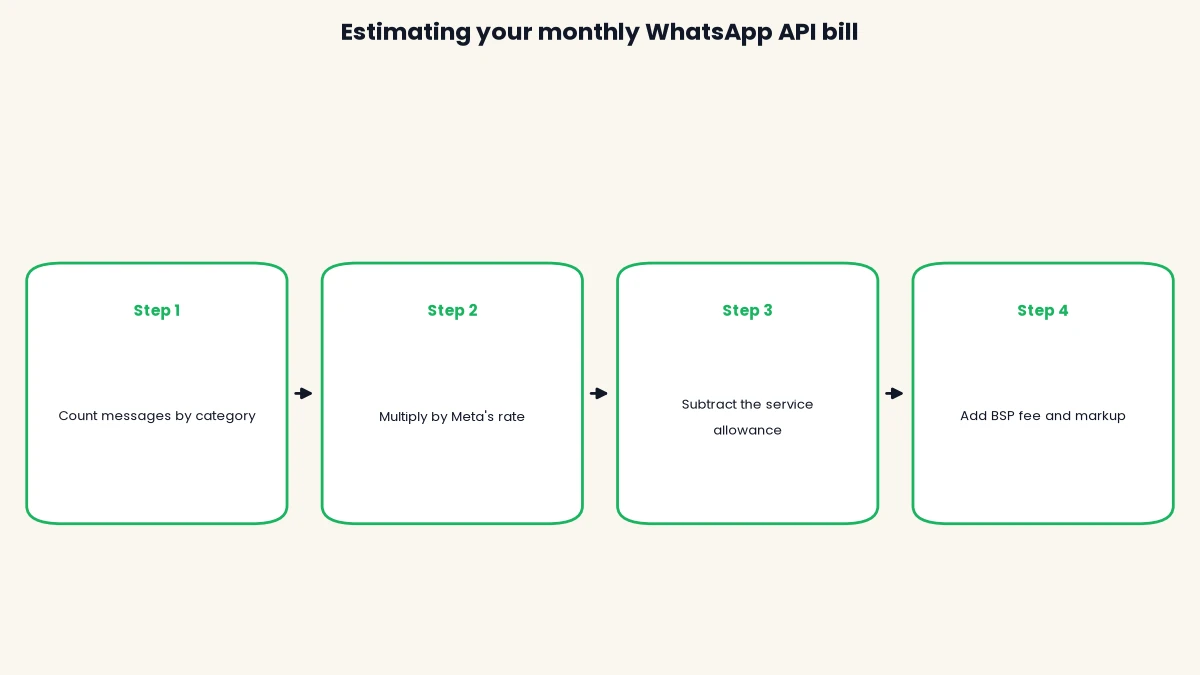
You can estimate your bill in about ten minutes with last month’s message log. Follow these four steps.
- Count messages by category. Export last month’s template sends and split them into marketing, utility and authentication. Count service replies separately.
- Multiply each count by Meta’s rate. Use the India rate card for your billing currency. Add 18% GST to the total.
- Subtract the service allowance. Apply the free monthly allowance for service messages per phone number, then price any service messages above it at the utility rate.
- Add your BSP’s platform fee and any markup. A flat fee is a fixed line. A markup is a percentage of the Meta total in step 2.
Repeat the sum for a busy month, because your costs will rise during festival season and product launches. A simple sheet with these four columns is enough for most businesses.
WhatsApp Business API vs the free app: pricing difference
The free WhatsApp Business app has no per-message charges from Meta. You download it, register a number and send messages, and Meta does not bill you for them. The API is metered because it adds features the app does not offer, such as multiple team logins, automation, chatbots and broadcasts to opted-in contacts.
If you only need one person to reply from one phone, the app is the cheaper choice. If you need a shared inbox or automated replies, the API is the right tool, and its costs follow the rate card above. Read our WhatsApp Business app vs API guide for the full feature comparison.
You do not have to pick one. DTB’s Coexistence option lets you keep using the WhatsApp Business app on the same number as the API. Check the limits of coexistence before you rely on it for a high-volume team.
How DTB’s pricing works
DTB is an official Meta Tech Provider. We charge a flat monthly plan fee and add no markup on Meta’s message charges. Meta’s charges are separate from the plan fee, and they are the same charges you would see from Meta directly.
| Plan | Monthly | Yearly | What is included |
|---|---|---|---|
| Basic | ₹500 a month | ₹5,000 a year (saves 17%) | Contacts, tags and segments, team inbox, bulk campaigns, message templates, campaign reporting |
| Pro | ₹1,499 a month | ₹14,999 a year (saves 17%) | Everything in Basic, plus AI chatbot and flows, automations, WhatsApp Flows builder, integrations, sales pipeline (CRM) and priority support |
Payments are processed by Razorpay. Subscriptions renew automatically and you can cancel at any time. You can also upgrade or change plans at any time.
Meta’s charges are separate from DTB’s plan fee, and DTB adds no markup on them. The billing mechanics for Meta’s charges, such as wallet top-ups or prepaid credits, are not covered here until they are confirmed.
If you are still choosing a provider, our guide to the best WhatsApp Business API providers in India compares the main options side by side. Start with the questions below before you compare plan prices.
Ready to see your real number? Start with DTB from ₹500 a month on Basic, or ₹1,499 on Pro, and compare the Meta charges with your current bill.
Questions to ask any BSP before you sign
Ask these questions in writing. A clear provider will answer them without hesitation.
- Is the per-message charge the same as Meta’s rate card? If not, ask for the markup as a percentage.
- What is the monthly platform fee, and what does it include? Check whether chatbots, automations and integrations sit on a higher plan.
- How do you bill Meta’s charges, and in which currency? Confirm the accounts are on INR billing before the deadline.
- Do you review templates before they go to Meta, and do you warn me when a template’s quality drops? Meta reviews every template, so ask what the BSP adds on top.
- What happens if my number is restricted? Read our guide to avoiding a blocked WhatsApp number so you know what to expect.
- What do I need to get started? Compare the document list with our WhatsApp Business API requirements for India.
Frequently asked questions
How much does WhatsApp Business API cost per month in India?
Your monthly cost is Meta’s per-message charges plus your BSP’s fee. Meta’s India rates are about ₹0.8631 per marketing message and ₹0.115 per utility or authentication message, before GST. A business sending 500 utility messages a month pays Meta about ₹68 including GST, and the BSP fee is added on top.
Is WhatsApp Business API free to use?
No. Meta charges per message for marketing, utility and authentication templates, and since 1 October 2026 also for service messages after a monthly free allowance per phone number. The free WhatsApp Business app has no per-message charges from Meta.
What is zero markup pricing on WhatsApp API?
Zero markup means the BSP passes Meta’s message rate through unchanged and earns its revenue from a platform fee. You can check this by comparing each per-message line on your invoice with Meta’s rate card.
What changed on WhatsApp API pricing on 1 October 2026?
Service messages, which are free-form replies inside the 24-hour customer service window, became billable after a monthly free allowance per business phone number. Utility templates sent inside an open service window also became chargeable at the standard utility rate. Marketing and outbound utility and authentication rates were not changed by this update.
What is the difference between WhatsApp Business app and API pricing?
The app is free with no per-message charges from Meta. The API is metered per message by category, plus your BSP’s fee, because it supports features the app does not, such as automation, multiple team logins and broadcasts to opted-in contacts.
Do I need a BSP to use WhatsApp Business API in India?
Most small and mid-sized businesses reach the API through a BSP, an approved provider that gives access to the API, templates and an inbox. That is why the BSP fee is a real second layer of cost on top of Meta’s rate.
Do I need to move my WhatsApp billing to INR?
Yes, if any of your WhatsApp Business Accounts are still billed in another currency. Partner reports say accounts must move to INR by 31 December 2026, and Meta stops delivering messages from non-INR accounts from 1 January 2027. Confirm the deadline in Meta Business Manager.
WhatsApp Business API pricing in India comes down to two numbers: Meta’s per-message rate for your mix of templates, and your BSP’s fee. Meta’s rate card is the same whichever provider you use, so the choice of provider decides the rest. Estimate your bill from last month’s message log, then compare each provider’s fee and markup against that estimate. For the wider picture, start with our guide to the best WhatsApp Business API providers in India.
Want a clear estimate for your business? Book a free demo and we will walk through your message volume and plan with you.