

WhatsApp follow up for dormant real estate leads is how you turn a database of old enquiries sitting untouched in a spreadsheet into bookings, without spending a rupee on fresh ads. Most builders and brokers only ever message a lead in the first few weeks after they enquire, then let anyone who did not convert quietly disappear from the pipeline.
Quick answer: treat a lead as dormant once they have gone 60 to 90 days with no reply after your normal follow-up sequence has ended, segment them by what they originally wanted before you message anyone, send one reactivation touch every quarter rather than a weekly nudge, and lead with real news (a price change, a new tower, updated availability) instead of “just checking in.” Because these contacts have not heard from you in a while, treat the message with more care than a fresh follow-up, not less.
Key takeaways
- Call a lead dormant after 60 to 90 days of silence following your normal follow-up sequence, not after a single unanswered message.
- Segment dormant contacts by what they originally enquired about before sending anything. A single broadcast to the whole database performs worse and risks your quality rating.
- Lead with genuine news, a price revision, new inventory, a possession update, rather than a generic “are you still interested” message.
- Run a reactivation campaign quarterly or around real project milestones, not on a weekly schedule.
- In DTB, build the list with tags and the contacts list’s last-active date, then run it as a scheduled campaign to that tag.
Published 3 October 2026 by the Digital Toolbox team. Meta’s opt-in and quality rating rules checked the same day against Meta’s developer documentation.
In this guide
- What counts as a dormant real estate lead?
- Why reactivating a dormant lead needs more care
- Segment your database before you message anyone
- How to build a whatsapp follow up for dormant real estate leads campaign in DTB
- What to send a dormant lead
- How often to run a reactivation campaign
- Measuring whether reactivation is working
- How DTB helps
- Frequently asked questions
What counts as a dormant real estate lead?
A lead is dormant once your normal follow-up sequence has ended and 60 to 90 days have passed with no reply, no site visit, and no activity you can see. That is a practical guideline, not a rule Meta or anyone else sets, so adjust it to how long your own sales cycle usually takes. A plotted-land project with a slower decision cycle might wait 90 days before calling a lead dormant. A ready-to-move apartment with buyers deciding in weeks might call it at 45.
The distinction matters because a dormant lead needs a different message than someone three days late replying to a site visit invite. Treating both the same, usually by sending the exact same follow-up template regardless of how long someone has been silent, is the most common mistake in this area. An Ahmedabad broker running three active projects at once often has this problem without realising it: the same “any update?” template goes out to a lead who enquired yesterday and one who enquired five months ago, because nobody separated the two lists.
| Status | Signal | What it needs |
|---|---|---|
| Active | Replied or visited within the last 30 days | Your normal follow-up sequence |
| Cooling | 30 to 60 days since the last reply | One more direct, specific nudge before giving up |
| Dormant | 60 to 90+ days with no reply, visit or activity | A quarterly reactivation touch, not weekly follow-up |

Why reactivating a dormant lead needs more care
Messaging someone who has not heard from you in months carries more risk than messaging someone mid-conversation, because they are less likely to remember opting in and more likely to block or report a message that feels out of nowhere. Meta tracks blocks and reports per number and turns them into a quality rating, and a sustained drop in that rating limits how many people you can message at all. Our guide on avoiding a WhatsApp number block covers the full mechanics; the short version here is that a dormant list is exactly the kind of send that pushes a block rate up if it is rushed.
Meta’s opt-in documentation does not set an expiry date on consent, so a lead who opted in eight months ago is still technically opted in. The practical risk is not a compliance breach, it is that the person has forgotten who you are, which is a human problem a careful message solves better than a policy one. Keep the first reactivation message short, specific to what they originally asked about, and easy to opt out of.
This is also why a dormant list should never be the first list you test a new template on. Send a new reactivation template to a small, recent, warm segment first, watch how it performs, and only roll it out to the full dormant list once you know the wording lands well. A template that reads fine to someone mid-conversation can land very differently with someone who has not thought about your project in months.
Segment your database before you message anyone
A single broadcast to every dormant contact in your database treats a buyer who wanted a 3 BHK the same as someone who asked about a plot an hour away, and it shows. Group dormant contacts by what they originally cared about before you decide what to send.
- By project or configuration interest. Someone who asked about a specific tower or unit size should hear about that tower first, not a generic update.
- By where they dropped off. A lead who never visited needs a different reactivation message than one who visited and then went quiet after seeing the payment plan.
- By lead source. A lead from a paid ad campaign and a referral from an existing buyer have different expectations of how personal the message should feel.
- By budget range, if you captured it. Sending a premium tower update to someone who enquired about your most affordable configuration wastes the message and the message allowance.
DTB’s segments support nested AND/OR rule groups, so a segment such as “tagged 3bhk-interest AND tagged dormant” is a normal, buildable rule rather than a manual list someone has to maintain by hand.
How to build a whatsapp follow up for dormant real estate leads campaign in DTB
Be upfront about what DTB can and cannot automate here. There is no built-in “message everyone who has been silent for 90 days” trigger, since automations start from a segment a contact enters or from Welcome, not from a date comparison on their own. The reliable way to run this is a short, repeatable manual review paired with DTB’s existing tagging and campaign tools.
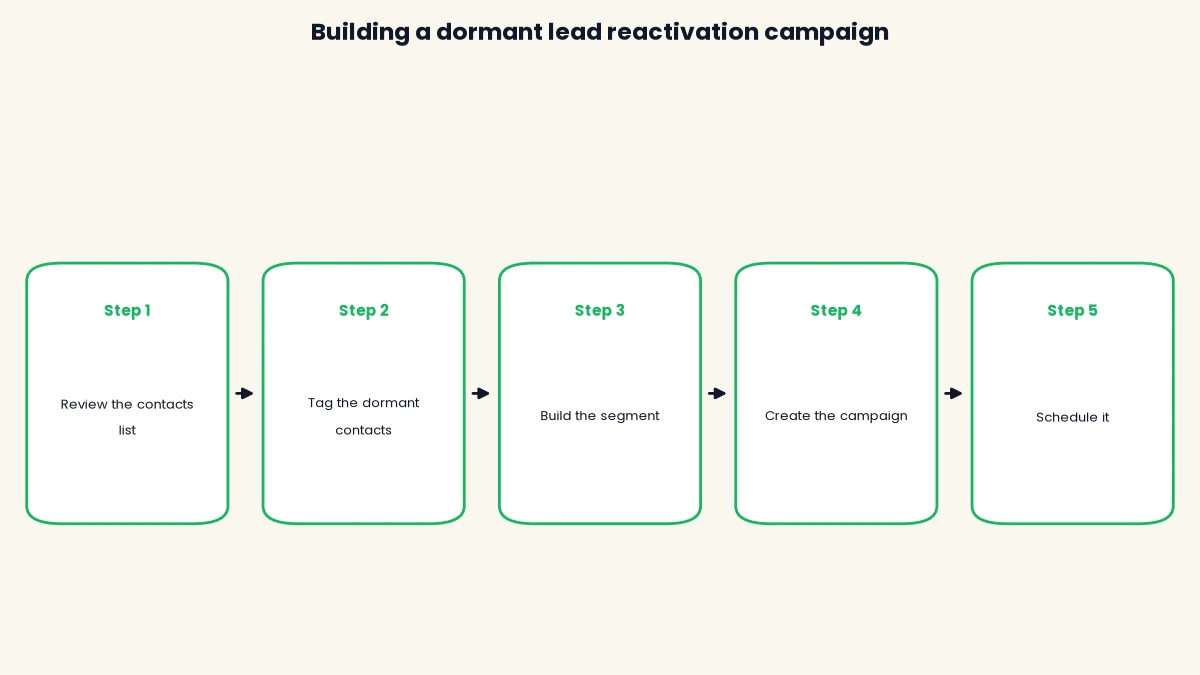
- Review the contacts list. DTB’s contacts list shows each contact’s last active time alongside their segments and tags, so sorting or scanning by that column surfaces who has gone quiet.
- Tag the dormant contacts. Apply a tag such as “dormant-q4” to everyone past your 60 to 90 day threshold, either one by one from the list or by exporting the contact list to CSV, marking the dormant rows, and re-importing with bulk tagging.
- Build the segment. Combine the dormant tag with an interest tag, for example “dormant-q4” AND “3bhk-interest,” using the segment rule builder’s nested AND/OR logic.
- Create the campaign. Target the segment directly, using an approved template written for a reactivation touch, not your original enquiry template.
- Schedule it. Use Send later to send during business hours rather than immediately, and avoid stacking it with your warm-lead follow-ups on the same day.
This is a monthly or quarterly task for one person on the team, not a one-time setup. Put a recurring reminder on someone’s calendar to re-run the review, since a dormant list quietly grows every week as this month’s active leads become next quarter’s dormant ones.
Measuring whether reactivation is working
Track the same send against the same segment every quarter so you can tell whether the approach is improving or not, rather than judging a single campaign in isolation.
- Delivery and read rate. DTB’s dashboard shows a delivery breakdown with delivery rate and read rate for recent sends, so a dormant campaign with an unusually low read rate is worth a closer look before you send the next one.
- Reply rate on the campaign. A handful of replies from a few hundred dormant contacts is a realistic, healthy outcome. Zero replies across several campaigns in a row usually means the message or the segment needs rework, not that the whole approach has failed.
- Template performance over time. DTB tracks per-template analytics, so comparing a few different reactivation templates across quarters shows which opening line and which kind of news actually gets a reply.
- Quality rating after the send. Check your number’s quality rating in the days after a dormant campaign goes out, since this is the send most likely to move it if the list or message was off.
What to send a dormant lead
The content of the message matters more here than in any other kind of follow-up, since you only get one real chance before a weak message trains the contact to ignore or block your number. The common failure is a message that gives the reader nothing new to react to.
| Weak reactivation message | Strong reactivation message | |
|---|---|---|
| Opening line | “Hi, just checking in, are you still interested?” | “Hi Priya, Aarohi Heights now has 2 units left in the tower you looked at.” |
| What it assumes | The reader remembers the full conversation | The reader needs reminding what project this is about |
| Call to action | None, or a vague “let us know” | One specific, easy next step: see updated pricing or book a fresh visit |
| Opt-out | Missing | A clear line or reply option to stop future updates |
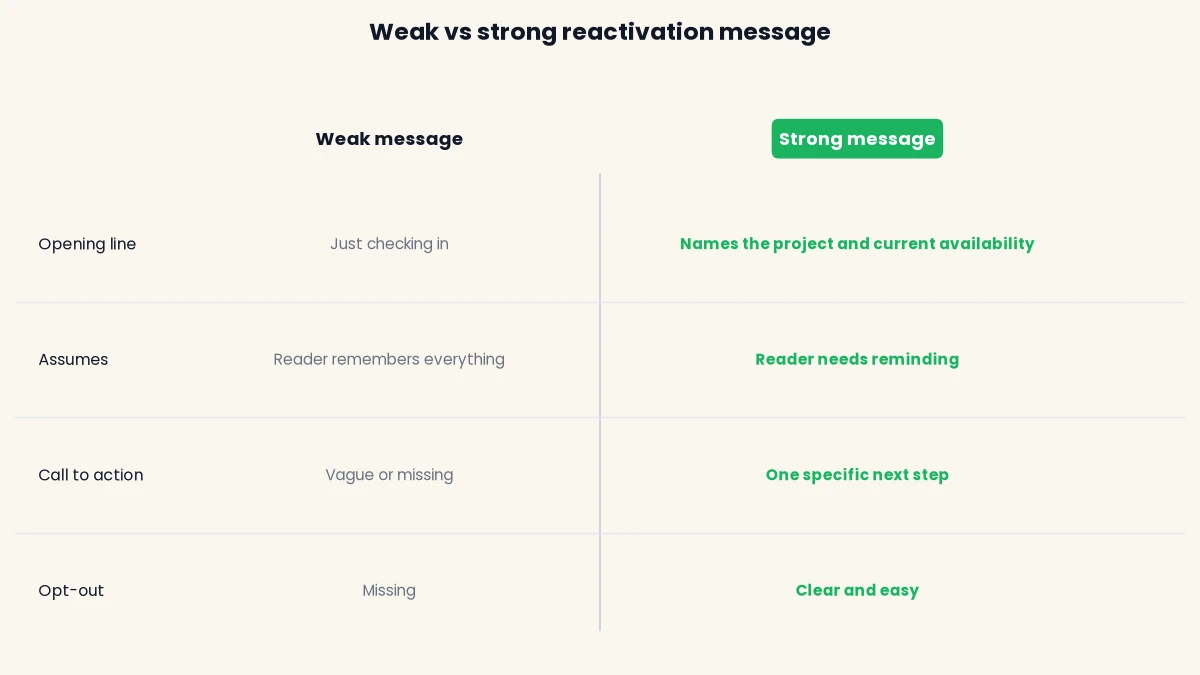
The strong version works because it gives the reader a reason to open the conversation that has nothing to do with whether they still remember your sales pitch. A price change, a shrinking unit count or a possession update is information the reader did not have before, which is a different kind of message than a request for them to re-engage on your behalf.
How often to run a reactivation campaign
Run a dormant lead campaign quarterly, or tied to a real milestone, whichever comes first. A weekly or even monthly cadence to the same dormant list reads as pestering someone who already chose not to respond, and it is the fastest way to turn a dormant contact into a blocked one.
Milestones worth triggering an off-cycle reactivation send include a price revision, a new tower or phase launch, a possession or handover update, or a festival-linked offer. Outside of those moments, the quarterly cadence is enough. Keep a simple log of when each segment was last messaged so two different team members do not accidentally send two reactivation campaigns to the same list in the same month.
A Pune broker managing several ongoing projects can use the same quarterly rhythm across all of them without it turning into constant noise, since each project’s dormant segment is tagged and messaged on its own schedule rather than everyone receiving every project’s news. The log doubles as a record of which segments have gone a full year without a single reactivation touch, which is usually the list most overdue for one.
Book a free demo and DTB’s team will help you set up the tags and segments for your own dormant lead list.
How DTB helps
DTB is an official Meta Tech Provider, so every whatsapp follow up for dormant real estate leads campaign you build runs on the same WhatsApp Business Platform rules as your active pipeline, not a separate or riskier channel. The parts of DTB that make this workable are:
- Contacts with last active time. The contacts list shows message count and last active time per contact, which is what makes spotting dormant contacts possible without a separate tool.
- Tags, manual or rule-based. Apply a dormant tag by hand, or set a filter rule so a tag applies itself to matching contacts, with bulk tagging and CSV import and export for larger lists.
- Nested segment rules. Combine a dormant tag with an interest tag using AND/OR logic, so the reactivation list is specific rather than your whole database at once.
- Scheduled campaigns. Target a tag or segment directly and send immediately or schedule with Send later, with a live preview of the template before it goes out.
Conclusion
Done well, whatsapp follow up for dormant real estate leads turns a database most teams write off into a cheap source of fresh bookings, using contacts you have already paid to acquire once. Define dormant clearly, segment before you send, lead with real news, and keep the cadence quarterly rather than constant. See our WhatsApp automation for real estate guide for the active-lead side of the funnel, and our WhatsApp broadcast for real estate guide for the compliance details behind any broadcast-style send. If you are still choosing a platform to run any of this on, see our comparison of WhatsApp Business API providers in India and our WhatsApp Business app vs API guide. Start with DTB at ₹1,499/month and bring your old database back into the pipeline.
Frequently asked questions
How long should a real estate lead go quiet before you consider them dormant?
60 to 90 days of no reply, no visit and no activity after your normal follow-up sequence has ended is a reasonable starting point. Adjust it to your own sales cycle: a faster-moving ready-to-move project can use a shorter window than a longer-cycle plotted development.
Is it safe to WhatsApp message leads who have not replied in months?
Meta’s opt-in rules do not expire consent after a fixed time, so it remains technically allowed. The real risk is that the contact has forgotten who you are, which raises the chance of a block or report, so keep the message specific, short and easy to opt out of rather than treating it as a routine send.
What should a reactivation message say to a dormant lead?
Lead with real news specific to what they originally asked about, such as new availability, a price change or a possession update, instead of a generic “are you still interested.” Give one clear next step and a visible way to opt out of future messages.
How often should you run a dormant lead reactivation campaign?
Quarterly is a sensible default, with an extra off-cycle send for a genuine milestone like a new tower launch or a price revision. Messaging the same dormant list weekly or monthly reads as pestering and increases the chance of being blocked.
Do I need fresh opt-in to message a lead who went quiet months ago?
No, the original opt-in still applies since Meta does not set an expiry on consent. You do not need to collect it again, though a careful, specific message matters more here than for an active lead.
How do I find dormant leads in my database?
Sort or scan your contacts list by last active time to see who has gone quiet, then tag those past your chosen threshold. In DTB, this can also be done by exporting contacts to CSV, marking the dormant rows, and re-importing with bulk tagging.
Should dormant lead reactivation use a marketing or utility template?
Marketing, in almost every case. A reactivation message about new availability, pricing or a project update is promotional by nature, so it needs the marketing category rather than utility, which Meta’s template categorization rules reserve for non-promotional follow-ups tied to something the contact already did.